Last Beacon: Survival
- 4.3
- Rating
- 1.00M
- Installs
- Free
- Price

 Analysis by App-foxy
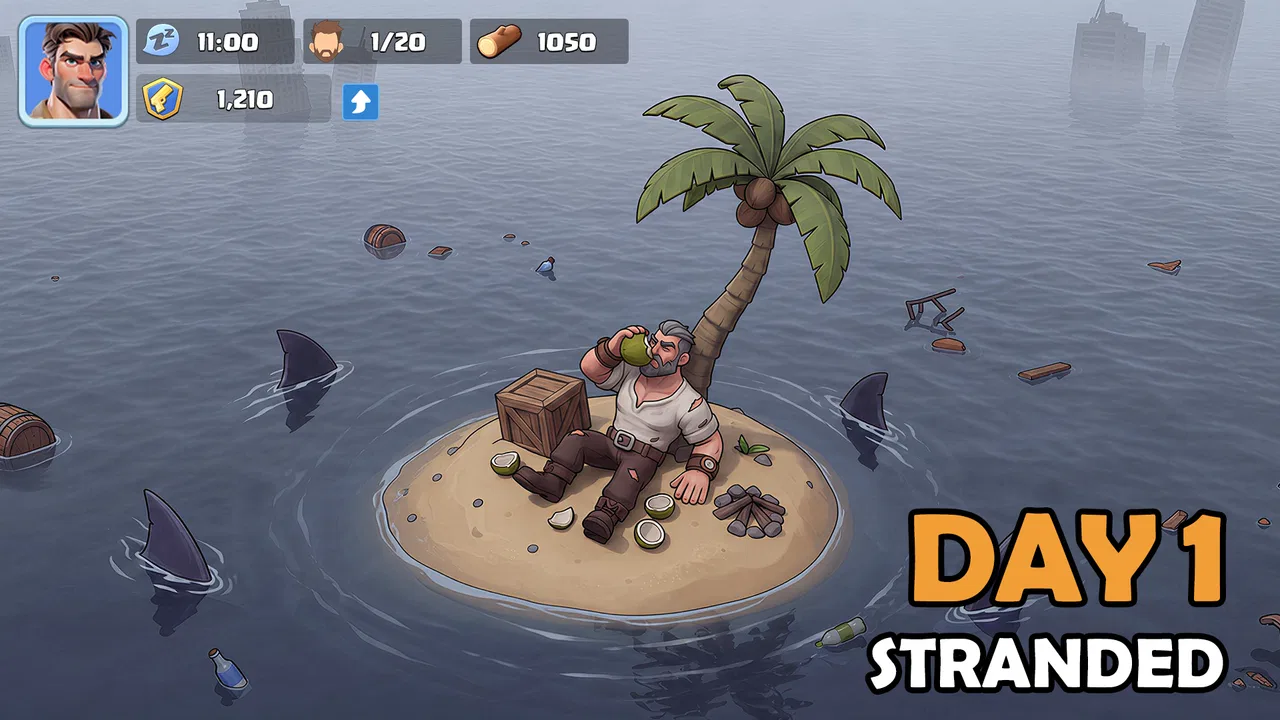
I went into Last Beacon: Survival expecting a strategy game built around difficult choices, and that is exactly the kind of experience its premise suggests: humanity has been pushed onto the ocean, and every decision is tied to survival, construction, and the long-term effort to restore civilization. It is a free game from YG Technology FZ-LLC, aimed at players aged Everyone 10+, and it sits in a space where planning matters more than quick reflexes.
What makes the concept appealing to me is the combination of a harsh setting and a constructive goal. You are not simply defending a finished base or collecting resources in a comfortable town. The central fantasy is rebuilding something meaningful in an environment that should make every improvement feel earned. That gives the game a more focused identity than a standard city builder, even before considering how its individual systems work in practice.
After spending time with it, my broad recommendation is fairly simple: this is worth trying if you enjoy survival strategy and like watching a settlement gradually become more capable. I would be more cautious if you want a fully transparent competitive game, a short offline-style experience, or a strategy title with no possibility of spending pressure. The game is free to start, but optional purchases range from $0.99 to $29.99 per item, so the way you approach progression matters.
You May Also Like

 Pandora - Music & Podcasts
Pandora’s Music Is Easy to Start, but Harder to Recover
Pandora’s strength is its low-effort path from a seed to a station. Its weak spot is how much confidence it asks you to place in connection, setup, and quiet recovery.

 8 Ball Pool
 Is Built on Rivalries, Rematches, and Routine
A close look at the rivalries, rematches, shared routines, and unanswered safety questions that turn a quick pool match into a persistent mobile community.

 Samsung Music
’s Quiet Strength Is Playing What You Already Own
Its reach comes less from spectacle than from dependable access to a personal library. That simplicity is both the app’s strongest retention engine and its ceiling.

 AccuWeather: Weather Radar
AccuWeather Review: A Quick, Clear Forecast for Everyday Decisions
For everyday plans, the best forecast is the one you can understand quickly. AccuWeather makes rain timing, radar, and local conditions easy to act on, with a few trade-offs.

 Hill Climb Racing
Why Hill Climb Racing Still Turns Crashes Into One More Run
A tiny car, a bumpy hill and one more upgrade: Hill Climb Racing keeps resurfacing because its simple chaos makes every near-miss feel personal.

 AliExpress - Shopping App
AliExpress Makes Global Shopping Feel Personal, but Shoppers Bear the Risk
AliExpress turns a global marketplace into a pocket-sized discovery engine. Its reach is useful, its shopping loop compelling, and its trade-offs easy to miss.
More From Our News Desk
View All News


Building a future on a moving foundation
The ocean setting gives the game a useful source of tension. In many strategy games, expansion happens across stable land, and the player’s biggest challenge is usually deciding where to place the next building. Here, the idea of surviving at sea changes the emotional tone. A new structure is not only an upgrade; it represents another step away from collapse and another piece of a future that did not previously exist.
I like that the premise naturally supports several kinds of play. One player may focus on efficient development, trying to make every part of the settlement serve a clear purpose. Another may be more interested in the narrative feeling of restoring human life after disaster. A third may enjoy the conflict side, where preparation and resource management determine whether the community can withstand pressure. The game’s strategy category is therefore a good fit, because the appeal comes from connecting decisions rather than tapping through isolated activities.
The most useful mindset is to treat each improvement as part of a chain. Spending resources on one area can delay another, so rushing toward a visually impressive upgrade may not always be sensible. I found it more satisfying to think in terms of stability first: secure the foundations that support continued growth, then take on more ambitious goals. That approach also makes setbacks easier to understand, because a failed push usually points back to an earlier planning decision.
A realistic everyday scenario shows where the game can fit well. If I have a short break, I can check the settlement, decide which need deserves attention, and leave with a clear next objective. During a longer session, I can think through expansion and conflict in more detail. That makes it more flexible than a strategy game that only feels rewarding when played for a long uninterrupted stretch.
Why the setting changes the way I plan
The ocean is not just decoration in the game’s identity. It encourages a different relationship with space and risk. When the entire civilization is associated with a limited, exposed environment, careless growth feels less attractive than deliberate development. I found myself asking whether a new commitment would strengthen the settlement or simply create another demand to manage.
That is one of the more interesting lessons in the design: visible progress can still be fragile. A larger settlement may look like success, yet it can also create more pressure if its supporting systems are not ready. My practical tip is to avoid treating every available upgrade as an automatic priority. Before committing, I would check what it enables, what it consumes, and whether it helps the next problem I am likely to face.
This also makes the game more approachable for players who enjoy planning but do not necessarily want a complicated spreadsheet simulator. The theme gives decisions an understandable context. You are not improving a statistic simply because a menu says so; you are trying to make an ocean-bound society more resilient. That context helps the strategy feel personal rather than mechanical.
Progress feels best when I resist the rush
Survival games often create a temptation to chase the next milestone immediately. Last Beacon: Survival works better, in my opinion, when I slow down enough to understand the cost of momentum. Fast expansion can be exciting, but it may also leave the settlement less prepared for the next challenge. The strongest progress comes from recognizing which improvements create lasting flexibility rather than short-term spectacle.
A useful habit is to keep one objective in mind while preserving room for an unexpected problem. If every resource is committed in advance, a sudden setback can force an unpleasant pause. Holding back a modest reserve may feel inefficient, but it gives the settlement options. That trade-off is more important here than simply maximizing growth at every moment.
This is also where the game may frustrate players who prefer constant rewards. Strategy requires accepting periods in which the best move is preparation rather than visible expansion. I appreciate that rhythm, but I know it will not suit everyone. If your ideal mobile game delivers rapid upgrades with little planning, this may feel slower and more demanding than expected.
Spending, fairness, and the limits of what can be judged
The purchase context deserves attention because the game is free to download and includes in-app purchases priced from $0.99 to $29.99 per item. That range tells me to approach progression carefully, especially if I am competitive or easily tempted by convenience. It does not, by itself, prove that spending is required, nor does it prove that every competitive situation is perfectly balanced. The fair conclusion is that players should test the free experience before deciding whether any purchase is worthwhile.
I would personally set a spending boundary before getting deeply invested. A low-cost purchase can feel harmless in isolation, while repeated convenience spending can change the character of a supposedly free game. My advice is to judge purchases by whether they add enjoyment or merely remove an obstacle that the game has deliberately placed in front of you. If the latter becomes the main reason to spend, I would step back.
For a player focused on rebuilding and planning rather than competition, the purchase question may be less important. Someone who treats the game as a relaxed strategy project can stop at the free path if it remains enjoyable. A player who wants to progress as quickly as possible, keep pace with stronger opponents, or avoid waiting may view the available items differently. The same pricing structure can therefore feel reasonable to one person and uncomfortable to another.
Competitive fairness is harder to assess without making assumptions about systems that are not clearly established here. I would not promise that spending has no effect, and I would not claim that it automatically determines outcomes. Instead, I would separate two questions: can a careful player enjoy the strategic loop without paying, and does spending create an advantage in the activities that matter most? The first question can be explored by playing free; the second should be judged cautiously rather than guessed.
That uncertainty is important for anyone choosing a strategy game mainly for competition. If your priority is a tightly controlled contest where purchases are completely irrelevant, you may be happier with a title designed around a clearly fixed competitive ruleset. Last Beacon: Survival is more attractive to me as a survival-building experience first, with competition treated as something to evaluate personally rather than blindly assume to be fair.
How I would play without overspending
I would begin by learning the basic progression and identifying which activities actually advance my settlement. I would avoid buying anything during the first sessions, because early enthusiasm can make every shortcut look valuable. Once I understood where my time and resources were going, I could decide whether a purchase supports the way I genuinely play or simply encourages me to skip the planning that makes the game interesting.
Another practical rule is to compare convenience with permanence. A purchase that helps once may be less meaningful than an improvement that changes how I approach the game, but I would still want to know exactly what I am receiving before spending. Since individual items can cost as much as $29.99, I would never treat the largest option as a routine part of play. The free entry point is the best way to discover whether the core loop earns that level of commitment.
Families should also discuss purchases before handing the game to younger players. The age rating is Everyone 10+, but that does not remove the need for sensible spending controls. I would explain that the game can be played without automatically buying every offer and would make sure the device’s purchase settings match the household’s expectations.
Where it stands beside familiar strategy alternatives
Compared with a traditional city builder, this game’s strongest distinction is its survival framing. A conventional builder may focus mainly on growth, layout, and optimization. Last Beacon: Survival adds the emotional weight of rebuilding after disaster, which makes defensive thinking and resource choices feel more urgent. If you want a calm construction sandbox, another option may be better. If you want development to feel like recovery, this setting has more pull.
Compared with a pure survival game, it appears more interested in civilization-scale progress than in the moment-to-moment struggle of one character. That makes it a better match for players who enjoy directing a community or settlement rather than managing only personal equipment and immediate danger. Someone seeking constant action may find a more combat-focused alternative more satisfying.
It also differs from quick competitive strategy games because the ocean-rebuilding premise gives decisions a longer horizon. The appeal is not only winning the next encounter; it is creating enough stability to keep moving forward. That longer view is a strength for patient players, but it can feel like friction if you want every session to end with a decisive victory.
Who should try it, and who should pass?
I would recommend it to players who like resource decisions, gradual development, and settings with a clear sense of stakes. It is especially suitable if you enjoy checking a settlement, choosing a priority, and returning later to see whether your plan worked. The game’s free price makes that experiment easy, and its 100K+ installs suggest that it has already found an audience beyond a tiny group of early adopters.
I would also suggest it to fans of mobile strategy games who are tired of ordinary medieval kingdoms or familiar modern cities. The ocean-bound civilization theme gives the rebuilding loop a distinct personality. Even when the underlying decisions resemble other strategy games, the setting encourages me to interpret them as part of a larger survival story.
I would skip it if I dislike waiting, resource trade-offs, or the possibility of purchase pressure. I would also look elsewhere if my main goal is a purely competitive game with an unquestionably level playing field. Players who want a completely self-contained experience with no commercial distractions should be especially cautious before investing a lot of time.
Device compatibility is reasonably broad: the current version is 1.3.1 and it supports Android 6.0 or later. That makes it accessible to people who are not using a recent phone, although actual comfort can still depend on the device and on how demanding the game feels during longer sessions. I would start with short play periods on an older device and see whether navigation remains comfortable before committing to a long-term settlement.
Questions I would answer before installing
Can I enjoy it without paying? I would begin with a clear yes in practical terms: the game is free to start, and I would use that access to decide whether the core survival and building loop is enjoyable. I would not assume that every later stage feels identical without spending, but I also would not buy anything before understanding the free progression.
Is it mainly for casual players or serious strategists? It can serve both, but in different ways. Casual players can use short sessions to make one or two sensible decisions, while more committed players can study the relationship between development, preparation, and conflict. The game rewards attention, so it is not ideal for someone who wants to tap through without thinking.
Does the ocean theme matter beyond the story? For me, yes. It gives the rebuilding objective a stronger identity and makes limited space and vulnerability feel central to the experience. I would not choose it solely for the setting, but the setting is a major reason the strategy feels more distinctive than a generic settlement game.
Should I spend money to compete? I would not make that assumption. The available purchases mean spending is part of the game’s context, but the sensible approach is to play first, observe how progress feels, and decide whether competition is important enough to justify any cost. If equal conditions are your top requirement, choose a game whose monetization and competitive rules are more explicitly aligned with that goal.
Is it suitable for younger players? Its content rating is Everyone 10+, so it is positioned for a broad audience, but I would still supervise spending and discuss in-app purchases with younger players. The strategic themes may be accessible, while the commercial decisions require adult guidance.
My trust verdict after weighing the trade-offs
Last Beacon: Survival has a premise I find easy to remember: humanity is rebuilding on the ocean, and survival depends on turning a fragile refuge into a functioning civilization. That focus helps it stand apart from ordinary builders and gives its strategic decisions a meaningful backdrop. I enjoyed it most when I treated progress as a sequence of careful commitments rather than a race toward the next impressive upgrade.
Its main caution is not the concept but the surrounding uncertainty of free-to-play progression. With individual purchases reaching $29.99, I would keep spending under deliberate control and avoid treating convenience as a requirement. I would also be measured about competitive fairness until I had personally seen how much influence purchases have in the activities I care about.
The game is currently listed at a 4.3 average from around 4K ratings, with around 196 written reviews, and it is free to try. Those figures make it look like a reasonable candidate for a test run, but they should not replace your own judgment about pacing and spending. My recommendation is to install it if the idea of rebuilding civilization at sea genuinely appeals to you, play without purchasing first, and decide based on whether the planning itself remains satisfying.
My final take: this is a promising strategy choice for patient players who want survival, construction, and long-term decision-making in one setting. I would recommend it to a friend who enjoys thoughtful mobile progression and can maintain a firm spending limit. I would point that friend elsewhere if they wanted instant action, guaranteed competitive equality, or a game with no purchase considerations at all.
FAQs for Last Beacon: Survival
01What is Last Beacon: Survival about?
Last Beacon: Survival is a post-apocalyptic survival game focused on exploration, resource gathering, crafting, and base development. You must search dangerous environments for food, materials, equipment, and clues while managing health and other survival needs. The game combines adventure and progression with threats that can make every expedition risky, so planning and careful resource management are important from the beginning.
02Can Last Beacon: Survival be played offline?
Offline availability may depend on the version, device, and specific game features. Core survival activities may be accessible without a constant connection, but online services, updates, cloud saves, advertisements, events, or other connected features can require internet access. Before downloading, check the store listing and test the game with your connection disabled if offline play is especially important to you.
03Is Last Beacon: Survival free to download and play?
Last Beacon: Survival can generally be downloaded at no initial cost, but free access does not always mean that every feature is completely unrestricted. Depending on the platform and release, the game may include advertisements, optional purchases, premium resources, or progression-related offers. Review the in-app purchase information before installing, particularly if children will use the device.
04What devices are compatible with Last Beacon: Survival?
Compatibility depends on the operating system, device model, available storage, and the minimum version required by the current release. Because survival games can use considerable processing power, older phones or tablets may experience longer loading times, reduced visual quality, heating, or occasional performance issues. Always confirm the latest Android or iOS requirements on the official download page.
05What should new players know before starting?
New players should expect to spend time collecting materials, learning crafting recipes, improving equipment, and deciding when it is safe to explore farther from a secure location. Resources should not be wasted early, and returning to base before supplies run out is often wiser than taking unnecessary risks. Progress can also feel gradual, so patience and preparation are essential.
Pros
- Atmospheric post-apocalyptic setting with strong visual tension.
- Exploration rewards curiosity with hidden areas and useful supplies.
- Survival mechanics create meaningful choices about resource usage.
- Enemy encounters keep progression challenging without constant combat.
- Works well for players who enjoy slow
- methodical adventure games.
Cons
- Resource shortages can make progress feel repetitive over longer sessions.
- Some objectives are not clearly explained
- causing unnecessary backtracking.
- Difficulty spikes may frustrate players who are new to survival games.
- The interface can feel crowded on smaller phone screens.
- Loading times may become noticeable on older Android and iOS devices.

Last Beacon: Survival
Gallery